# Do Headshots Matter for Remote Workers?
Here is a question I hear constantly from people who work from home: if nobody sees me in person, do I really need a professional headshot? My answer surprises them. Remote workers need a great headshot more than office workers do, not less.
Think about it. When you worked in an office, people formed their impression of you across hundreds of small moments: the hallway hello, the conference room presence, the way you carried yourself in a meeting. Working remotely, almost all of that is gone. What is left? A one inch circle next to your name on Zoom, Slack, and Teams. That tiny avatar is doing the job your entire physical presence used to do.
I have spent 27 years photographing people, from celebrities for GQ, Vogue, InStyle, and People to executives, founders, and job seekers. I have shot Lady Gaga, the Kardashians, Richard Branson, and Ella Beatty. And I can tell you this: the less face time you get in real life, the harder your photo has to work.
## The Thumbnail Is Your New Handshake
Let us look at the reality of remote work in 2026. According to Gallup, among remote capable U.S. employees, 52 percent now work hybrid, 26 percent are exclusively remote, and 22 percent are fully on site. That split has held stable since 2022. Remote work is not a phase. It is the permanent shape of professional life for a huge share of the workforce.
Now consider how those people actually interact. Zoom reports around 300 million daily meeting participants. Microsoft Teams passed 320 million monthly active users. Owl Labs found that U.S. workers average five online or hybrid meetings per week. Your face, or the small circle representing it, shows up in dozens of these interactions every single week.
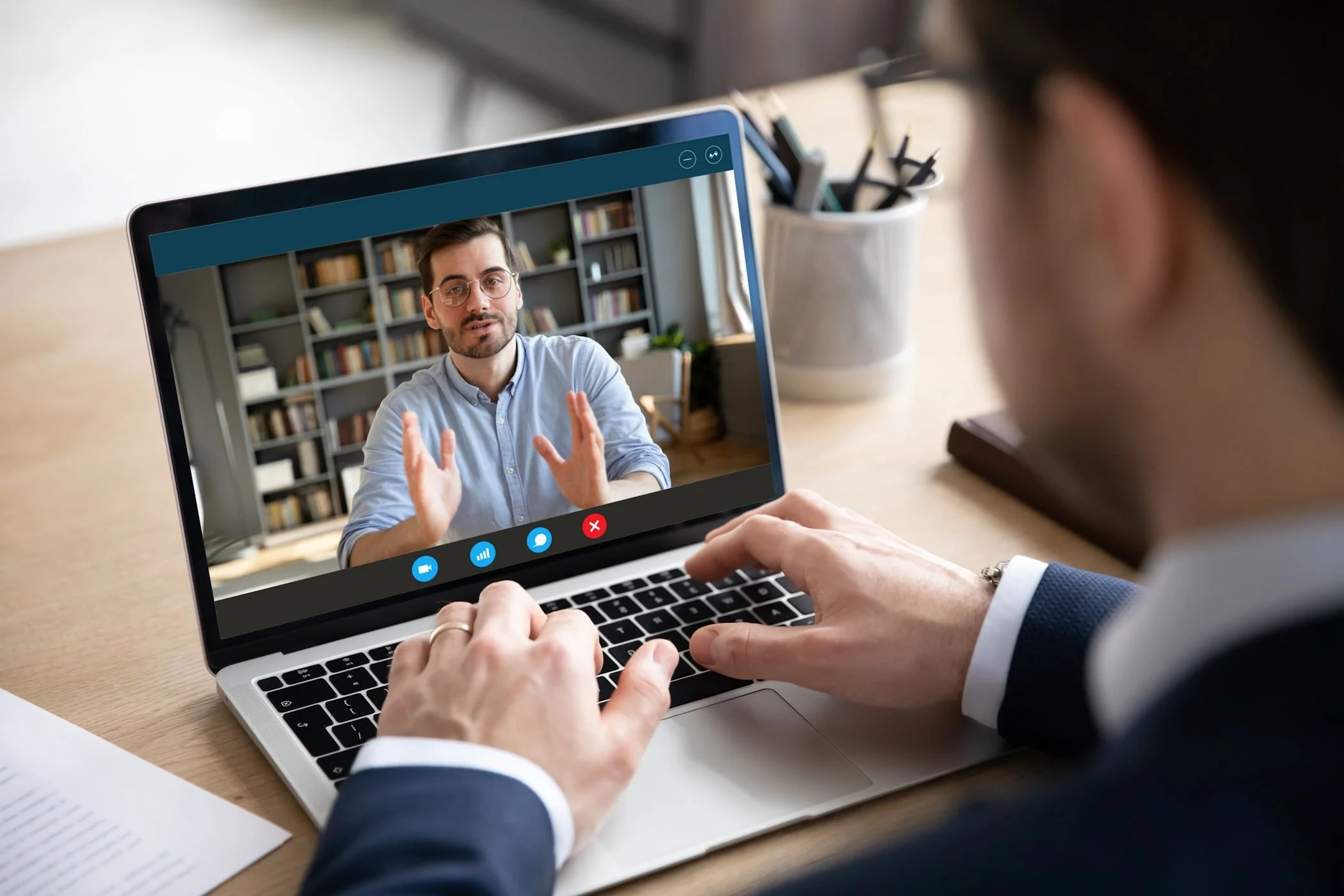
Here is the part that should get your attention. Princeton psychologists Janine Willis and Alexander Todorov demonstrated in 2006 that people form judgments about a face, trustworthiness, competence, likability, in a tenth of a second. One hundred milliseconds. That research was about faces in person. On a screen, in a one inch avatar, the judgment is just as fast and the information is far thinner. Your colleagues, your clients, and your manager are sizing you up from a tiny circle, and they are doing it in a blink.
An eye tracking study of LinkedIn profiles found that viewers spend 19 percent of their time looking at the profile photo, more than any other element on the page. People look at faces first, longest, and hardest. On Slack and Teams, where the photo is often the only visual identity you have, that instinct has nowhere else to go.
## Remote Hiring Managers Judge the Circle Too
This is not just about your current team. If you are job hunting remotely, your headshot is working even harder.
Remote hiring runs on async trust. The hiring manager may never meet you in person before making an offer. They see your resume, your LinkedIn, your portfolio, and your face. According to LinkedIn's own data, profiles with photos get up to 21 times more views and 36 times more messages than profiles without one. For a remote candidate, that photo is not decoration. It is the closest thing to a handshake the process allows.
I wrote separately about [whether you really need a professional headshot for your job search](https://www.dclee.net/blog/do-i-really-need-a-professional-headshot-for-my-job-search). That piece is about getting hired. This one is about what happens after you get the job: the daily grind of being a small circle on a screen, where credibility has to be rebuilt in every meeting because nobody sees you walk into the room.

A blurry webcam grab, a cropped vacation photo, or a five year old picture tells your remote colleagues something before you say a word. It says this person does not take their professional presence seriously. A sharp, current, professional headshot says the opposite, and it says it in every meeting, every message thread, every day.
## Camera On Is the New Showing Up
Let us talk about the video call itself, because your headshot and your camera presence are two halves of the same thing.
When your camera is on, your colleagues see you in real time. When it is off, and it often is, they see your avatar. Either way, the standard is set by your best image. A professional headshot as your avatar means the off camera moments still represent you well. It is the difference between a polished placeholder and a gray initial in a circle.
There is also a subtle leadership effect. On remote teams, the people with strong visual presence get remembered. Their faces are recognizable in a sea of tiles. Their avatars stand out in long message threads. This is not vanity. It is visibility, and visibility drives opportunity: the stretch assignment, the promotion, the introduction. Proximity bias is real in remote work. A great headshot is a small, legitimate counterweight.
## What Makes a Headshot Work at One Inch
A headshot that looks great on a website does not automatically work as a thumbnail. The tiny circle is a brutal format, and it rewards specific choices.
Simplicity wins. Busy backgrounds turn to visual noise at avatar size. A clean, uncluttered background keeps the focus on your face. This is one reason I shoot with natural light and a 50mm lens on my Leica M11. The 50mm sees the world the way the human eye does, and natural light renders skin the way people actually look. No strobes, no gimmicks. At one inch, honesty reads as confidence.
Expression matters more than ever. A subtle, genuine smile with engaged eyes survives the shrink. A blank corporate stare becomes a gray smudge of a face. When I direct, the eyes are everything: "The eyes are definitely the most important. I just have to make sure their eyes are open, that there is a catch light, that there is a great expression in the eyes." That catch light, the small reflection in your eyes, is what keeps a thumbnail feeling alive instead of flat.
Crop tight. Your face should fill the frame. A headshot where your body takes up half the image becomes a headshot where your face is a dot. And update it. If your avatar shows a person with different hair, different glasses, or a different decade, every video call starts with a small moment of confusion. Read my guidance on [how often you should update your headshot](https://www.dclee.net/blog/update-headshot-frequency) and put a reminder on your calendar. For remote workers, I recommend every two years at most.
One thing to skip: the AI headshot shortcut. "There is nothing wrong with AI headshot apps except they are not real." On a remote team, your colleagues will eventually see your real face on video. If your avatar is an AI polished stranger, the mismatch erodes trust instead of building it. Shoot your real face.
## The Executive Remote Worker
If you lead a remote or hybrid team, your headshot is doing management work. Your team looks to your avatar for cues about who you are. A strong, current executive headshot signals that you take the remote environment seriously, that you are present even when you are not in the room.
This matters in the complete guide to executive headshots in Los Angeles, where I break down what separates an executive portrait from a standard headshot. For remote leaders, the short version: invest in the image that represents you when you cannot be there in person, because most of the time, you cannot be there in person.
My retouching philosophy applies here too: "I leave the things that give people character. If it is a mole or something like that, it stays. If it is a blemish like a pimple, I take it out." Your remote team needs to recognize you, not admire a rendering of you.
## The Bottom Line
Remote work removed the hallway, the conference room, and the handshake. What it gave you in return is a one inch circle that represents you dozens of times a week to people who may never meet you in person.
With 52 percent of remote capable employees hybrid and another 26 percent fully remote, that circle is not a detail. It is your professional identity. A professional headshot is the highest leverage investment a remote worker can make: one session, and every Zoom tile, Slack thread, Teams call, and LinkedIn view works harder for you for the next two to three years.
My headshot sessions start at $1,500 for two looks. That is a full wardrobe and styling change per look, full direction so you never have to guess what your face should be doing, and images built to survive the brutal honesty of the one inch thumbnail. Your remote career deserves a face to go with the name.