# Should Men Wear Makeup for Headshots?
Short answer: yes, but you should never be able to tell. If anyone looks at your headshot and thinks "he is wearing makeup," something went wrong. The entire point is invisibility.
I have photographed men for 27 years, for GQ, Men's Health, Departures, corporate boardrooms, and law firm websites. Every one of those shoots involved some level of grooming and shine control. None of the finished photos look like the man is wearing makeup. That is the job. Here is the no-fluff guide.
## This Is Not About Looking Made Up
Let us clear the obstacle first. When photographers say makeup for men, they do not mean foundation, contouring, eyeshadow, or any of the things you are picturing. They mean three things: killing shine, evening out temporary redness, and taming the details the camera exaggerates.
The camera is brutally honest about skin. A modern sensor resolves more detail than the human eye picks up across a table. It sees the shine on your forehead from the walk to the studio. It sees the redness around your nose. It sees the flaky patch on your lip and the stray hair growing out of your ear. None of this registers when someone meets you in person, because human vision is forgiving and constantly moving. A photograph freezes it all in high definition.
Makeup for men is the correction for that gap between what people see in person and what the sensor records. It is not vanity. It is accuracy.
## The Shine Problem
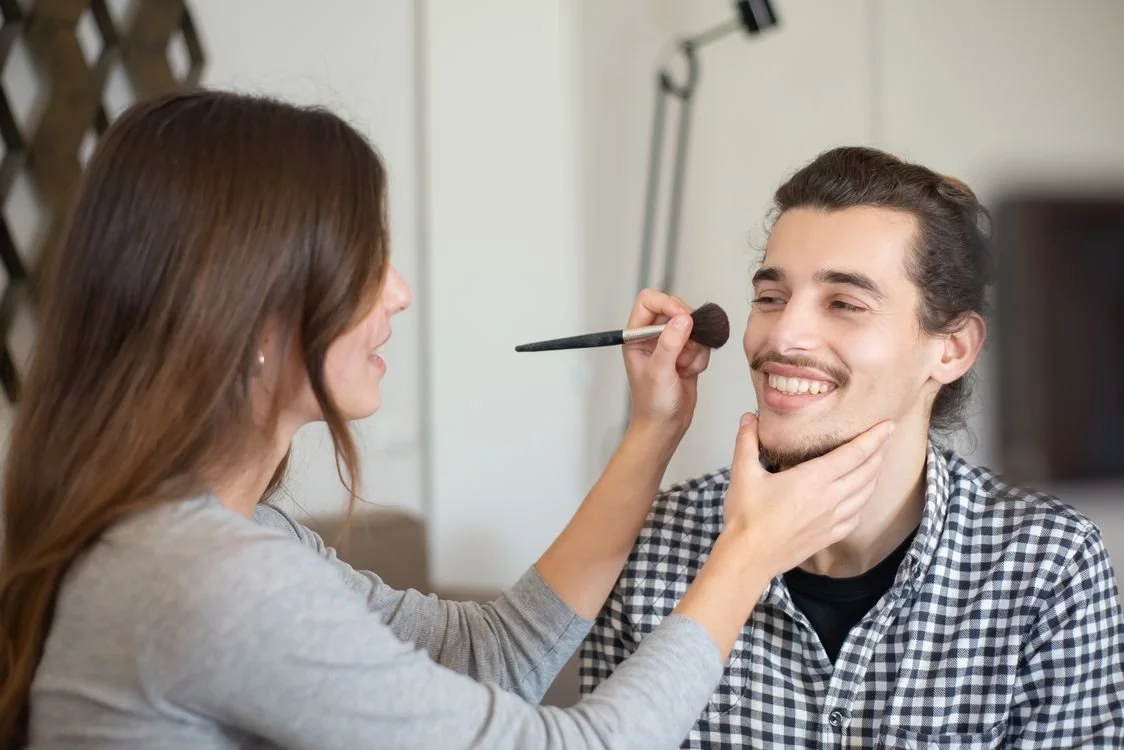
Shine is the number one enemy, and it affects almost every man who sits in front of my camera. Foreheads shine. Bald heads shine spectacularly. Noses shine. Under studio lighting, a shiny forehead becomes a bright hotspot that pulls the eye away from your eyes, which is exactly where the eye should be going.
"The eyes are definitely the most important. I just have to make sure their eyes are open, that there is a catch light, that there is a great expression in the eyes." Anything competing with the eyes is a problem, and shine is the most common competitor.
The fix is absurdly simple: powder. A translucent mattifying powder, applied to the forehead, nose, and anywhere else that catches light, kills shine for the duration of a session. It takes ninety seconds. It is invisible. It is the single highest return on investment in all of men's grooming for photography, and most men have never done it once.
Blotting papers work too, and they fit in a jacket pocket. Keep them. Use them between looks. Shine comes back as the session goes on, especially under warm lights.
## What "Makeup" Actually Means on a Men's Shoot
Here is the full kit, demystified. This is what a makeup artist does for a male client in the fifteen minutes before we start shooting.
Powder for shine control, as above. Translucent, matched to nothing because it has no color, just a matte finish.
Spot coverage for temporary redness. A blemish, razor burn, the red patch where your collar rubbed. A tiny amount of concealer, blended to nothing. The retoucher can remove these later, but it is faster and cleaner to handle the obvious ones before the shutter fires.
Lip balm. Dry, flaky lips photograph terribly. A plain, non-glossy balm applied ten minutes before the shoot is invisible and transformative.
Brow tidy. Not shaping, not threading, just brushing. A spoolie brush through the eyebrows takes five seconds and removes the wild hairs that the camera loves to feature.
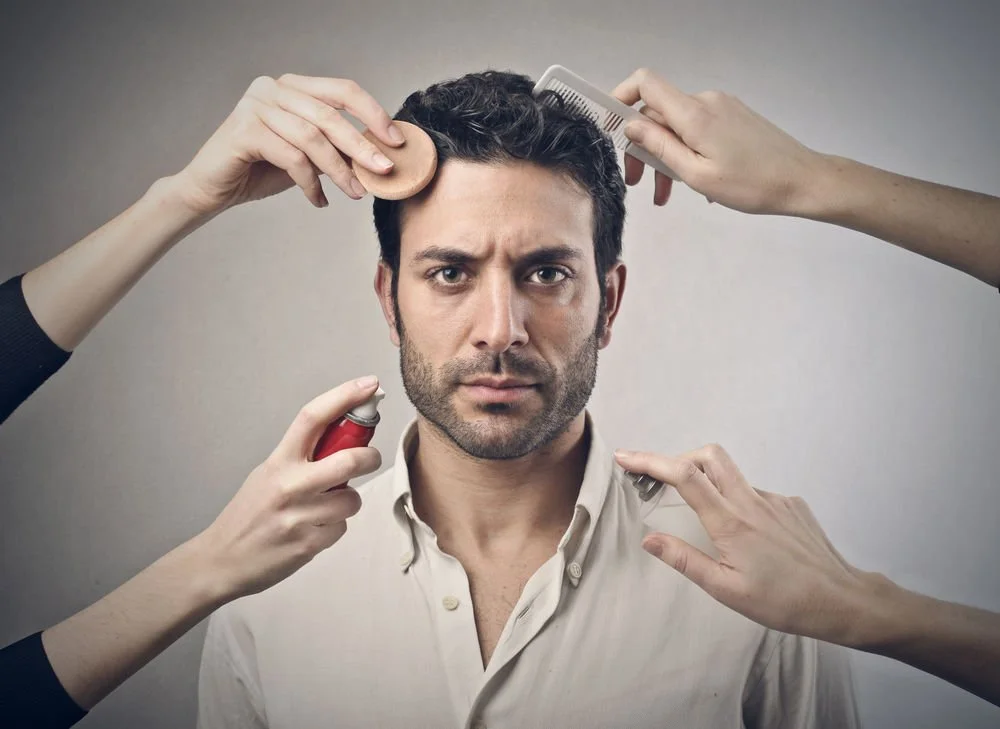
Nose and ear check. Stray hairs get trimmed. This is the detail nobody wants to talk about and everybody is grateful for afterward.
That is the whole list. No foundation. No color. No contour. Ninety percent of men's makeup for headshots is powder and lip balm.
## When a Makeup Artist Earns Their Fee
Now the real question: do you need to hire one, or can you handle it yourself?
Hire the makeup artist when the stakes are high. Executive portraits, personal branding shoots, acting headshots, anything where the images will live on a website, a book cover, or a campaign. A professional makeup artist does in fifteen minutes what takes an amateur forty, and they see things you cannot see in your own mirror. They know how products behave under specific lighting. They know that what looks fine in the green room looks different under the key light.
A makeup artist also manages the session. Shine returns. Hair moves. Collars shift. Having someone whose entire job is watching these details while I watch your expression means neither of us is distracted from our real work. On my branding shoots, the makeup artist is as essential as the camera.
For a deeper breakdown of the cost and value calculation, read my guide on whether hair and makeup are worth it for your headshot. The math surprises most people.
## The DIY Kit: Twenty Dollars and Five Minutes
For a standard headshot session, or if you are doing your own prep, here is everything you need.
Translucent mattifying powder and a brush or puff. Blotting papers. Plain lip balm, applied well before the shoot so it absorbs. A spoolie for the brows. A small pair of grooming scissors for the obvious strays.
Do this in order: shower, moisturize lightly, arrive with clean skin. Apply lip balm first so it has time to settle. Powder goes on last, right before we shoot, because its job is to control the shine the lights will create. Do not apply powder over heavy moisturizer or sunscreen, or it cakes. Less is more. You are removing shine, not painting a wall.
One warning: avoid anything with SPF right before a shoot if you can. Some sunscreens create a white cast on camera, especially under flash or strong lighting. If you need sun protection that day, use it in the morning and blot it down before the session.
## What Never to Do
Do not borrow your partner's tinted moisturizer in a shade that is almost right. Almost right is visibly wrong on camera. Do not apply foundation across the whole face. It changes your skin tone relative to your neck and ears, creating a mask line the camera will find. Do not use anything shimmery or "illuminating." Shimmer is shine with marketing. Do not get a haircut the day before the shoot. Fresh cuts photograph harshly. A week of grow-in looks natural.
And do not skip grooming because you think retouching will fix everything. Retouching fixes blemishes. It cannot fix a shiny forehead convincingly, because shine is not a surface mark, it is blown-out highlight data. Once the pixels are clipped to white, the detail is gone. Powder before the shoot beats Photoshop after it, every time.
## The Confidence Factor
There is a psychological layer here that matters. Most men walk into a headshot session slightly uncomfortable. They do not do this often. They are unsure what to do with their hands, their face, their expression. The five minutes of grooming before we start serves a second purpose: it is a transition. You sit down, someone takes care of the details, and by the time you are in front of the camera, you have settled. You look in the mirror and you look ready.
That readiness shows. Directing a relaxed subject is a completely different experience from directing a tense one. I spend every session analyzing the face, the jawline, the eyes, finding the angles that work. That work goes twice as fast when the subject trusts the process, and the grooming ritual is where that trust starts.
## The Bottom Line
Should men wear makeup for headshots? Yes. Powder, lip balm, and a brow brush. Invisible, fast, and the difference between a photo that looks like you on a great day and a photo where your forehead is the brightest thing in the frame.
Hire the artist for high-stakes shoots. DIY the basics for everything else. Either way, handle shine before the shutter fires, because no retoucher can recover what a blown highlight destroyed.
My headshot sessions start at $1,500 for two looks, and I send every client a preparation guide before we shoot covering grooming, wardrobe, and what to expect on set. Review what to wear for your headshot while you are at it, and check my headshot photography techniques so you know exactly what happens on set. Remember the wardrobe rule too: "Always shoot the tie and shoot the no tie. You always want to have that option." Bring the powder. I will bring the rest.