# Is Your Phone Good Enough for a LinkedIn Headshot?
I am going to give you the answer most photographers will not. Yes, sometimes your phone is good enough. And sometimes it is quietly costing you opportunities you will never know about. The difference is not the phone. It is knowing which situation you are in.
I have spent 27 years shooting people for GQ, Vogue, InStyle, People, Teen, Men's Health, and Departures. I shoot on a Leica M11 with a 50mm lens because it is the best glass, the best colors, very flattering, and the 50mm sees the world the same way the human eye does. I just prefer it. I also carry a phone with a very good camera in my pocket like everyone else. I have seen what both can do, and I have seen exactly where the phone hits its wall.
Here is the honest breakdown.

## The Stakes Are Higher Than They Feel
Before we talk about cameras, talk about what the photo is doing. LinkedIn's own data shows that profiles with a photo get up to 21 times more profile views and up to 36 times more messages than profiles without one. An eye-tracking study found that viewers spend 19 percent of their time on a LinkedIn profile looking at the profile picture, more than any other element on the page. Your face is doing nearly a fifth of the work of your entire profile.
That is the math that makes this question worth taking seriously. A headshot is not decoration. It is the first filter between you and the recruiter, the client, the hiring manager. So the real question is never "is my phone good enough in general." It is "is my phone good enough for the specific job this photo has to do."
## When a Phone Shot Absolutely Works
There are situations where a phone photo is the right call, and I will tell you exactly what they are.
If you need something today, a phone shot taken well beats no photo by a mile. A blank LinkedIn profile is invisible. A decent phone photo puts you in the game. Speed has value.
If the use is low stakes, a phone is fine. Internal company directories, a Slack avatar, a conference badge, a guest bio on a podcast page. Nobody is judging your career on these. They just need to recognize you in the hallway.
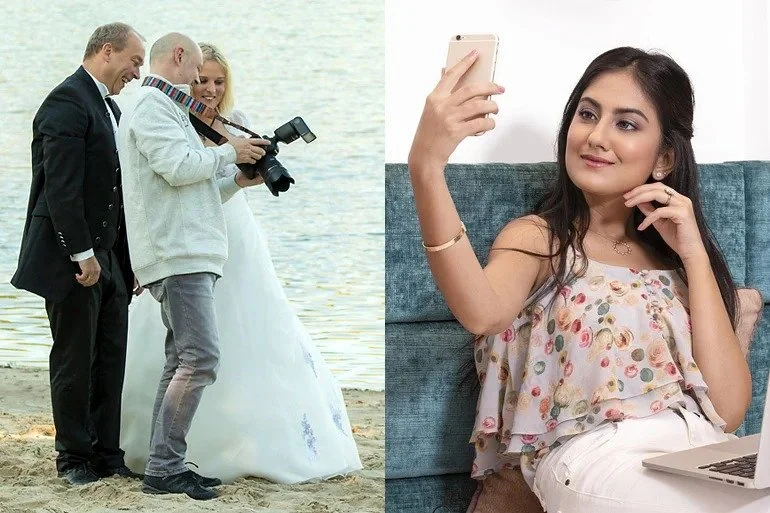
And here is the part people miss: a phone shot taken correctly can be genuinely good. I have seen phone portraits that would fool most viewers. They all share the same recipe. The phone is not held at arm's length. It is on a tripod or propped up, shot with the rear camera and a timer or a friend pressing the shutter. The subject stands near a large window with soft daylight on their face. The background is clean and uncluttered. The person is wearing something solid and simple. That photo will beat a bad professional headshot every time, because a bad professional headshot with harsh flash and a fake smile is worse than a good honest phone photo.
So if you have a recent phone, a bright window, and ten minutes, you can make something respectable. I am not going to pretend otherwise.
## Where the Phone Hits Its Wall
Now the other side. There are three walls, and they are all physics, not snobbery.
The first wall is the lens. Phone cameras, even the good ones, use wide-angle lenses for the front camera and for selfies. Wide-angle lenses distort faces at close range. They enlarge whatever is closest to the lens, which is usually the nose, and they stretch the edges of the face. This is why selfies so often look "off" in a way you cannot quite name. You look at a selfie and think you look tired or strange, but what you are actually seeing is optical distortion. A professional shooting a 50mm or 85mm lens from eight to ten feet away renders your face the way people actually see it. I shoot a 50mm because it matches the human eye. Your phone's front camera does not.
The second wall is light. Phone cameras are remarkable in good light and helpless in bad light. The problem is that most people take their LinkedIn photo in the worst light available: overhead office fluorescents, a dim bedroom, backlit against a window so the face goes dark. A photographer does not just own better lights. A photographer sees light. I walk into a room and I am reading where the window is, what color the walls are bouncing, where the shadows fall across a jawline. That reading of light is most of the craft, and no phone can do it for you.
The third wall is direction, and it is the biggest one. Nobody looks good thinking about the fact that they are being photographed. When you shoot yourself, you are performing two jobs at once: subject and director. You cannot watch your own expression the way a photographer watches it. You cannot see that your left eye is squinting slightly, that your chin needs to come forward half an inch, that your smile just went stiff. I spend every session analyzing the face in front of me, the jawline, the eyes, finding the angles. And above all: "The eyes are definitely the most important. I just have to make sure their eyes are open, that there is a catch light, that there is a great expression in the eyes." A catch light is the tiny reflection of the light source in your eyes. It is what makes eyes look alive. Getting it requires positioning the light relative to the face deliberately. A selfie almost never has a real one.
## The AI Headshot Question
You might be wondering about the third option, the AI headshot apps. They are everywhere now, they cost a fraction of a photo shoot, and the results can look polished. My position is simple: there is nothing wrong with AI headshot apps except they are not real.
That matters for one specific reason. Trust. A recruiter who has seen a thousand AI portraits can spot the tells, the overly smooth skin, the slightly wrong teeth, the dead eyes. And even when they cannot spot it consciously, something in the image reads as slightly off. Your headshot has one job, which is to make a stranger feel like they know what you look like. A synthetic face cannot do that job, because it is not your face. It is a statistical guess at your face.
## What a Professional Actually Does Differently
People think they are paying for the camera. They are not. The camera is the least of it. Here is what you are actually buying.
You are buying lens choice. The right focal length at the right distance, so your face is rendered the way humans see it.
You are buying light reading. Natural light only, in my case, no strobes, but placed and shaped with intention. Window light is free. Knowing where to stand in it is the profession.
You are buying direction. Someone whose entire job is to watch your face and tell you what to do with it. Chin down a fraction. Think of something funny. Relax the shoulders. Hold that. This is the part clients always mention afterward. They walk in nervous and walk out amazed, not because of the camera, but because someone finally told their face what to do.
You are buying culling and retouching. A session produces hundreds of frames. The photographer picks the twelve where everything came together, and retouches them with a philosophy. Mine is simple: "I leave the things that give people character. If it is a mole or something like that, it stays. If it is a blemish like a pimple, I take it out." You do not get that judgment from a phone.
And you are buying options. In my sessions we shoot multiple looks, because having choices later is worth more than saving twenty minutes now.
## The Decision Framework
So here is how to decide, honestly.
Use your phone if the need is immediate, the stakes are low, and you can follow the recipe: rear camera, tripod or friend, big soft window light, clean background, solid clothing. That photo will serve you well until you can do better.
Book a professional if you are job hunting, fundraising, building a personal brand, speaking on stages, running for anything, or appearing anywhere your face is the product. If the photo has to earn you money, treat it like the business asset it is. That is also the moment to think carefully about whether you really need a professional headshot for your job search and [whether professional headshots are worth it at your specific career stage.
There is no shame in the phone photo. There is only the question of whether the opportunity in front of you deserves better. Most of the time, for the photo that represents your entire professional life to the world, it does.
## The Bottom Line
Your phone is a remarkable camera attached to a terrible portrait studio. It can work when the light is kind, the lens is kept at a distance, and the stakes are low. It fails exactly where it matters most: rendering your face truthfully, lighting it beautifully, and directing the life in your eyes.
If you decide the moment calls for a professional, start finding a headshot photographer near you who shoots the way you want to be seen. My sessions start at $1,500 for two looks, shot on a Leica M11 with a 50mm lens in natural light, with full direction so you never have to guess what your face should be doing. Bring your phone too. I will show you the difference side by side, and then you will never have to wonder again.