October 22, 2026 is a real date on the camera calendar. Two lenses ship the same day, both constant F2.8, both aimed squarely at photographers who carry their gear all day. The Sigma 50-120mm F2.8 DC OS Contemporary at $799, and the Tamron 20-40mm F2.8 Di III VXD for Nikon Z at $729.
I shoot headshots for a living in Los Angeles. Twenty-seven years, Leica M11 with a 50mm as my personal kit, natural light only. When I evaluate a lens, I ask one question: does this earn a place in the bag on a shoot day? Here is the honest breakdown of both lenses, the portrait math that matters, and what early testers are actually saying.
## The two lenses, the numbers first

### Sigma 50-120mm F2.8 DC OS Contemporary
Announced October 8, 2026. Ships October 22, 2026 at $799 USD.
- Mounts: Sony E, Fujifilm X, Canon RF. No Nikon Z or L-Mount at launch, though Sigma will sell it with a mount conversion service later.
- Format: APS-C. Roughly 75 to 180mm full-frame equivalent on Sony E and Fujifilm X, about 80 to 192mm on Canon RF.
- Weight: 390 grams on Sony E and Fujifilm X, 410 grams on Canon RF. Length: 99mm on Sony E. Filter thread: 55mm.
- Aperture: constant F2.8, 11-blade rounded diaphragm, stops down to F22.
- Stabilization: optical stabilization rated 6.5 stops at 50mm and 4.5 stops at 120mm under CIPA guidelines.
- Autofocus: HLA high-response linear actuator motor. Optical design minimizes focus breathing for video.
- Close focus: 23cm at 50mm, 55cm at 120mm. Maximum magnification 1:3 at the wide end, 1:4.7 at the tele end.
- Optics: 18 elements in 13 groups, including one FLD element, three SLD elements, and four aspherical elements.
- Build: dust and splash resistant, water and oil repellent front coating.
- Standout feature: a dedicated aperture ring, the first on any APS-C zoom in Sigma's Contemporary line.
- The big picture: it completes Sigma's constant F2.8 APS-C trio alongside the 10-18mm F2.8 DC DN and the 18-50mm F2.8 DC DN. All three together weigh under 1 kilogram. Sigma points out that a full-frame equivalent set weighs nearly three times that.
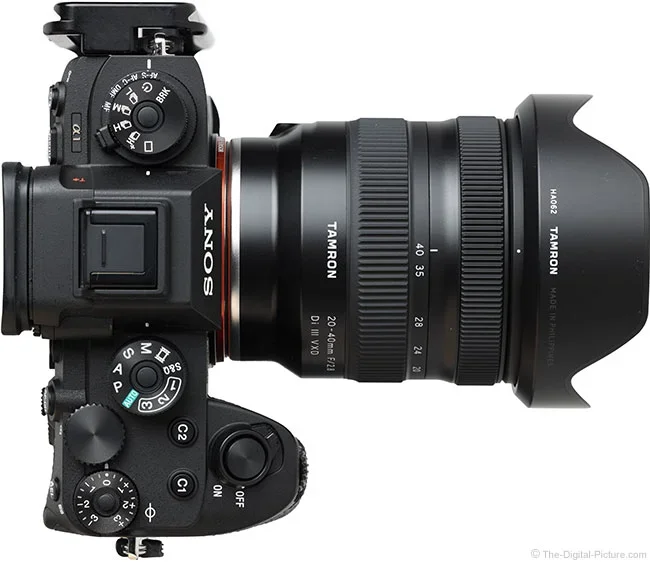
### Tamron 20-40mm F2.8 Di III VXD for Nikon Z
Announced October 8, 2026. On sale October 22, 2026 at $729 USD, $999 CAD, 709.99 euros, 614.99 pounds.
- Mount: Nikon Z, full frame. Model A062. Made under a license agreement with Nikon. The Sony E version has existed since 2022 at $699, 365 grams, and 86.5mm long.
- Range: 20 to 40mm, or 30 to 60mm equivalent on APS-C bodies.
- Weight: 380 grams. Length: 88.7mm. Diameter: 74.4mm. Filter thread: 67mm.
- Aperture: constant F2.8, 9-blade circular diaphragm, stops down to F22.
- Stabilization: none in the lens. You rely on the camera body's stabilization where it exists.
- Autofocus: VXD voice-coil extreme-torque drive linear motor. 65-degree zoom ring throw.
- Close focus: 0.17m at 20mm, 0.29m at 40mm. Maximum magnification 1:3.8 at the wide end, 1:5.1 at 40mm.
- Optics: 12 elements in 11 groups, including four low-dispersion elements and two glass-molded aspherical elements, with BBAR-G2 coating.
- Build: moisture-resistant construction, fluorine coating on the front element. Flower-shaped hood included. Supports Tamron Lens Utility software.
## The Sigma, read as a headshot photographer
This is the interesting one for portrait shooters. A 75 to 180mm equivalent range at constant F2.8 in a 390-gram lens is, functionally, a poor man's 70-200mm F2.8. That phrase comes straight from the DPReview forums, and it is accurate. The classic headshot focal lengths, 85mm, 105mm, 135mm, all live inside this zoom's range.
For headshot work specifically, the telephoto end is where this lens earns its keep. At 120mm, roughly 180mm equivalent, you get real compression. Faces flatten flatteringly, backgrounds melt, and you can work at a comfortable distance from the sitter. That distance matters more than most photographers admit. Subjects relax when the camera is not in their face. Some of my best headshot expressions happen at longer focal lengths precisely because the sitter forgets the lens is there.
The 6.5-stop stabilization rating at the wide end and 4.5 stops at the tele end is meaningful for available-light shooters. My night photography settings I actually use lean on high ISO and wide apertures, and stabilization is what lets you hold a slow shutter when the light drops. On bodies without in-body stabilization, which includes a lot of APS-C cameras this lens will mount on, in-lens stabilization is the difference between a usable frame and a blurry one.
The aperture ring is a genuine differentiator. Sigma's Mark Amir-Hamzeh, president of Sigma Corporation of America, called it out as a control long requested by photographers who prefer to set exposure by hand. For video headshots and interview framing, a physical aperture ring means smooth iris pulls without clicking through camera menus.
The honest caveats, and they matter. Early reviews from PetaPixel and Christopher Frost found the lens practical but noted, in the words of one DPReview forum summary, "clear weaknesses in sharpness when the aperture is wide open and in corner sharpness in general." The same discussion notes the lens shows its limits on high-resolution APS-C sensors and is happiest on 24 to 26 megapixel bodies. For headshot work, where the subject sits in the center of the frame, corner softness is largely irrelevant. Wide-open sharpness on the eyes is not. Test before you commit if you shoot a 40-megapixel body.
Also note what is missing: no focus mode switch, no OS switch on the barrel. Sigma stripped the controls to hit the size and weight. And there is no Nikon Z version, which stings for Z shooters because this focal range would pair beautifully with Nikon's DX bodies.

## The Tamron, read as a headshot photographer
The Tamron is a different animal and I want to be straight about its limits for headshot work. A 40mm maximum focal length does not give you a tight headshot. On full frame, 40mm is an environmental portrait lens. It puts the person in their world: the founder in the office, the chef in the kitchen, the creative against the city. That is a legitimate and lucrative genre, and it is exactly what this lens is built for.
What it does offer portrait shooters: a true 20mm ultra-wide end at F2.8 for interiors, architecture, and group environmental shots; 380 grams, which means it stays on the camera all day; a 17cm close focus at 20mm with 1:3.8 magnification, which is genuinely close for a zoom; and quiet VXD autofocus that reviewers praise for video.
The Sony E version has been in the wild since 2022, so we have four years of real-world data. PetaPixel's 2022 review found the images "rich, saturated, detailed, and sharp," praised the sun flare and starbursts, and found edge softness at the wide end that improves as you zoom longer. Photography Blog's conclusion called it sharp throughout the zoom range at center and edges, "more than good enough to effectively replace your typical wide-angle and standard f2.8 zooms." Amateur Photographer rated it 4.5 out of 5, praising compact build, image quality, and quiet focusing, while finding continuous autofocus less impressive than its other strengths. The recurring technical note: heavy reliance on software correction for distortion and vignetting, which is standard practice for modern compact mirrorless zooms.
The $729 Nikon Z price is a $30 premium over the $699 Sony E version. The Z version is also slightly larger and heavier than the Sony original: 88.7mm and 380 grams versus 86.5mm and 365 grams. Neither difference changes the buying decision.
For my own work, the Tamron's natural home is the environmental half of a branding session. I regularly shoot studio versus outdoor headshots in the same day, and a lens like this covers the outdoor environmental frames while a longer lens handles the tight portraits. If you shoot Nikon Z and do location branding work, this is the walkaround lens.
## What owners and early testers say
Both lenses ship October 22, so treat the Sigma commentary as early reactions from testers and reviewers rather than long-term owner reports. The Tamron benefits from four years of Sony E owner history.
On the Sigma 50-120mm, the DPReview forum thread on the announcement is enthusiastic with clear eyes open. One poster summed up the value proposition: "You can buy the whole trio for less than the price of a single high end OEM f2.8 zoom. Bravo Sigma! The industry needs more of this!" (DPReview Forums). Another, planning to buy for indoor youth basketball, wrote: "I'm buying one with closed eyes... it's going to be perfect for my children indoor basketball games where the 70-300 G was both too long and too slow..." (DPReview Forums). And the balanced counterpoint, summarizing the early video reviews: "Petapixel (formerly DPReview TV) and Christopher Frost were less enthusiastic in their reviews. While they found the lens practical, they also noted clear weaknesses in sharpness when the aperture is wide open and in corner sharpness in general." (DPReview Forums). That matches my read: superb concept and handling, optics that reward realistic expectations.
On the Tamron 20-40mm, FredMiranda forum users who have shot the Sony E version are direct. One wrote: "right now the perfect 2 lens setup would be the Tamron 20-40 f2.8 and Tamron 35-150 f2-2.8" (FredMiranda Forums). Another noted: "the newer 20-40 has tested sharper" than Tamron's own 17-28mm (FredMiranda Forums). The practical takeaway from the owner community: this is a lens people actually carry, not a lens that lives in the dry cabinet.
## Which one should you buy
Buy the Sigma 50-120mm if you shoot Sony E, Fujifilm X, or Canon RF in APS-C, and your work lives at the long end: headshots, portraits, events, indoor sports. At $799 and 390 grams, there is nothing else in this class. The 75 to 180mm equivalent range covers every classic portrait focal length. Just know the optical ceiling before you buy, especially on high-resolution bodies, and test wide-open eye sharpness yourself.
Buy the Tamron 20-40mm if you shoot Nikon Z full frame and need a compact everyday F2.8 zoom for travel, interiors, street, and environmental portraits. At $729 and 380 grams, it is the smallest fast standard zoom in the Z system and there is genuinely nothing else like the 20 to 40mm range. Do not buy it expecting tight headshots. Pair it with an 85mm prime and you have a two-lens location kit that weighs less than most single 24-70mm F2.8 zooms.
Buy neither if you need one lens to do everything. The Sigma starts at 75mm equivalent and the Tamron stops at 40mm. Between them sits the entire normal range, uncovered. That gap is the point. These are specialist lenses priced like generalists, and specialists reward photographers who know exactly what job they are hiring the lens for.
## The bottom line
October 22 gives us two honest lenses at honest prices. The Sigma is the portrait shooter's lens: long, fast, stabilized, and light enough to carry all day. The Tamron is the storyteller's lens: wide, fast, tiny, and built for the environmental frames that surround a portrait session. For corporate headshots in Los Angeles, where a session might run from tight studio portraits to environmental office frames in one booking, I can see both earning a place in the bag. The Sigma first. The Tamron when the job leaves the studio.
*David Christopher Lee is a Los Angeles celebrity and headshot photographer with 27 years of experience. He shoots headshots on a Leica M11 with a 50mm lens, natural light only, and writes about gear for working photographers.*
## Sources read
- Sigma Corporation of America official press release (Oct 8, 2026): https://press.sigmaphoto.com/product/10/sigma-announces-50-120mm-f2-8-dc-os-contemporary/ (price, ship date, mounts, weight, dimensions, optics, stabilization ratings, aperture ring, Mark Amir-Hamzeh quote, trio weight)
- Luminous Landscape, "Sigma 50-120mm F2.8 and 16-300mm Lenses Announced": https://luminous-landscape.com/sigmas-50-120mm-f2-8-makes-the-best-case-for-aps-c-in-years/ (spec table, full-frame equivalents, Nikon Z 16-300mm Nov 5)
- RedShark News, "Sigma 50-120mm F2.8 DC OS: price and release date": https://www.redsharknews.com/sigma-50-120mm-f2-8-dc-os-contemporary-aps-c-zoom (390g, removed switches, dust/splash notes)
- Shutterbug, "Tamron Brings Its Compact 20-40mm F/2.8 Zoom to Nikon Z": https://www.shutterbug.com/content/tamron-brings-its-compact-20-40mm-f28-zoom-nikon-z (announcement date, price, dimensions, weight, filter size)
- PetaPixel, "Tamron Offers Nikon Z Owners a One-of-a-Kind Wide-Angle Zoom Lens" (Oct 7, 2026): https://petapixel.com/2026/10/07/tamron-brings-its-unique-20-40mm-f-2-8-compact-zoom-lens-to-nikon-z/ (pricing, Nikon 14-30mm and 24-50mm comparisons)
- Cined, Tamron 20-40mm Nikon Z announced: https://www.cined.com/tamron-20-40mm-f-2-8-di-iii-vxd-for-nikon-z-announced-380g-full-frame-zoom-17cm-close-focus-vxd-linear-motor/ (no aperture ring, no stabilization, EUR/GBP pricing, moisture resistance)
- CameraJabber, Tamron 20-40mm Nikon Z specs: https://camerajabber.com/photography-news/tamron-20-40mm-f-2-8-di-iii-vxd-for-nikon-z-price-specifications-and-availability-announced/ (spec table, $30 premium over Sony E)
- CameraEgg, "Tamron 20-40mm F2.8 Di III VXD for Nikon Z: 380g, and $729 on October 22": https://www.cameraegg.org/tamron-20-40mm-f2-8-di-iii-vxd-for-nikon-z-380g-and-729-on-october-22/ (Sony E dimensions comparison, no VC)
- Ranzware, Tamron 20-40mm Nikon Z key specs: https://ranzware.com/tamron-brings-its-20-40mm-f28-zoom-to-nikon-z-mount-for-729 (full spec table, zoom throw, Tamron Lens Utility)
- Realhacker.news, "Tamron's Compact 20-40mm F2.8 Is Finally Coming to Nikon Z": https://realhacker.news/tamrons-compact-20-40mm-f2-8-is-finally-coming-to-nikon-z/ (review consensus on Sony E version, Nikon Z open questions)
- PetaPixel 2022 review of Tamron 20-40mm (Sony E): https://petapixel.com/2022/11/14/tamron-20-40mm-f-2-8-di-iii-vxd-review-tiny-yet-mighty/ (image quality, flare, edge softness, bokeh)
- Photography Blog conclusion, Tamron 20-40mm review: https://www.photographyblog.com/reviews/tamron_20_40mm_f2_8_di_iii_vxd_review/conclusion (sharpness verdict, value verdict)
- Fotovolo, Tamron 20-40mm F2.8 Di III VXD review: https://fotovolo.com/tamron-20-40mm-f2-8-di-iii-vxd-review (AF verdict, 4.5/5 equivalent assessment)
- DPReview Forums, "Sigma's 50-120mm F2.8 OS DC is an APS-C legend in the making, for just $799": https://www.dpreview.com/forums/threads/sigmas-50-120mm-f2-8-os-dc-is-an-aps-c-legend-in-the-making-for-just-799.4868846/ (community reactions, PetaPixel/Frost critique summary, trio value)
- DPReview Forums, "Sigma 50-120mm f/2.8 (or 18-50 / 10-18) on A7CR": https://www.dpreview.com/forums/threads/sigma-50-120mm-f-2-8-or-18-50-10-18-on-a7cr-iq-sharpness-in-crop-mode.4869017/ (crop-mode discussion, full-frame alternatives)
- AlphaShooters Sony Alpha Forums, Sigma 50-120mm rumor thread: https://www.alphashooters.com/community/threads/new-sigma-apsc-lens-50-120mm-f2-8.11793/ (55mm filter discussion, excitement)
- FredMiranda Forums, Sony forum thread excerpts: https://www.fredmiranda.com/forum/topic/1584193/10 (Tamron 20-40 + 35-150 two-lens setup quote, 20-40 sharpness vs 17-28)
- Tamron EU official newsroom, 20-40mm for Nikon Z: https://www.tamron.eu/en/newsroom/newsroom/20-40mm-f-2-8-di-iii-vxd-for-nikon-z-mount (official product description, close focus, VXD)
## Could not verify / left out
- Neither lens has shipped yet (both ship October 22, 2026), so all Sigma commentary is pre-release reaction and early review summary, not long-term ownership. I stated this in the article.
- I did not find Canadian or European pricing for the Sigma 50-120mm; only the $799 USD figure is confirmed.
- The Tamron Z version's autofocus behavior, correction profiles, and edge performance on Nikon bodies are untested by independent reviewers as of writing; I flagged this as an open question rather than assuming Sony E results transfer directly.
- Some outlets describe the Sigma's Canon RF full-frame equivalent as 80-192mm; Sigma's own materials say "roughly 75-180mm." I gave both with attribution.